Curvature change on grade
Work in progress: This section is still a work in progress — content is being added and revised continuously.
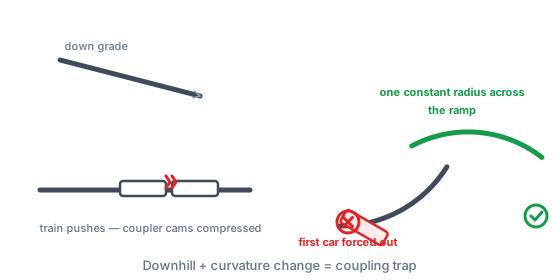
What is checked? Whether the curvature jumps within a ramp — straight→curve, radius change or reverse curve. Every ramp counts: in one of the two directions of travel it is always a down grade.
Why does it matter? Downhill the train pushes from behind while the locomotive holds back in front — every close coupler is under pressure and jams in its retracted position. As long as the curvature does not jump, that does no harm: with one constant radius the couplers settle once and never move again; with continuously changing curvature — in an easement — the same swing is spread over the whole length of the curve instead of falling due at a single joint. At a curvature jump they have to move all at once — at exactly the spot where the pressure holds them. The buffers meet and act like a rigid strut; in the curve their force points outwards, and the car between the pushing train and the holding locomotive is the weakest link. In a 2D plan the spot looks harmless — which is why it is almost always missed at the planning stage.
How bad is it? — the direction of travel decides. Pulled, the change is largely harmless: the train keeps the couplers extended, nothing has to move against the pressure. Pushing is what hurts — downhill by itself, during shunting on purpose. It gets worse with long cars (more swing per degree of curvature jump), a long heavy train behind the jump point and a tight radius after the jump.
How to fix it:
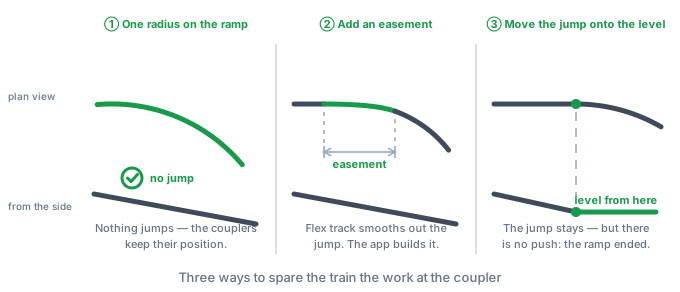
- Add an easement — a piece of flex track smooths out the jump, so the coupler extends gradually instead of all at once. The plan check builds one for you (“flex-track easement”).
- Keep one constant radius across the whole ramp — then the curvature never changes at all. This is exactly why helixes are built with a single radius throughout.
- Move the jump onto the level section — no grade, no push; no push, no jammed coupler.
Numbers & defaults: checked from 1.0 % grade. What is measured is the curvature at both ends of the joint — so what counts is the jump there, not whether the radius stays constant across the ramp. A curvature difference of 1.5 · 10⁻³ 1/cm counts as a jump (H0 value, scaled with the scale): Piko A R48 ↔ R54 counts, R90 ↔ R100 does not. Between two pieces of flex track the coarser threshold of 2.5 · 10⁻³ applies: the segments of a built easement chain meet with residual jumps of up to ≈ 2 · 10⁻³ — fitting noise of one and the same curve, not a real jump. A properly built easement therefore reports nothing: at its ends the jump stays below 1.5 · 10⁻³, inside it below the flex threshold. A reverse curve always counts, however small the jump.