Grade
Work in progress: This section is still a work in progress — content is being added and revised continuously.
What is checked? The grade of every route section (from the track heights) against the limit. In a curve the effective grade counts: curve resistance is added to the built grade, after John Allen’s rule of thumb 32 ÷ radius in inches, in percentage points. That holds for H0; the Trackplanner converts other scales by their track gauge. 2 % in a curve of 42 cm radius pull like almost 4 % in H0. The finding names the built grade and the surcharge. The warning triangle on the ramp, the height profile and the helix dialog calculate the same way.
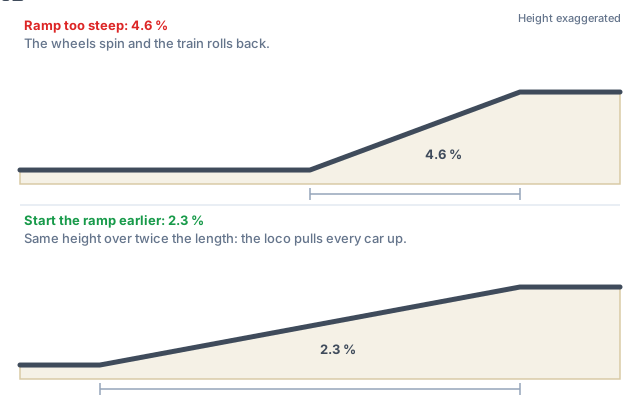
Why does it matter? On a ramp a locomotive doesn’t just pull the train, it lifts it. Rules of thumb: 2 % is comfortable, 2.5 % the upper recommendation, 3.3 % only for small layouts with short trains, 5 % a last resort. For very long trains (15+ coaches) stay below 1.25 %. European locos with traction tyres pull far more than models without them.
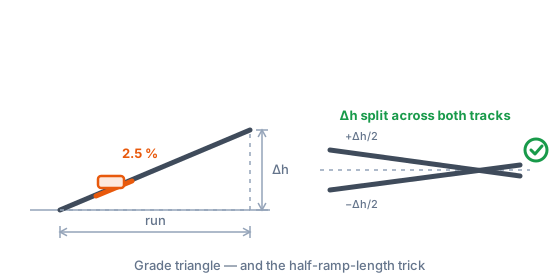
How to fix it: Lengthen the ramp, reduce the height difference — or, at over/underpasses, split the difference across both tracks (one drops, one climbs): halves the required ramp length.
Numbers & defaults: limit 2.5 % effective grade (editable). From 4 % the Trackplanner marks the spot red, with a higher limit only above it.