Fouling point
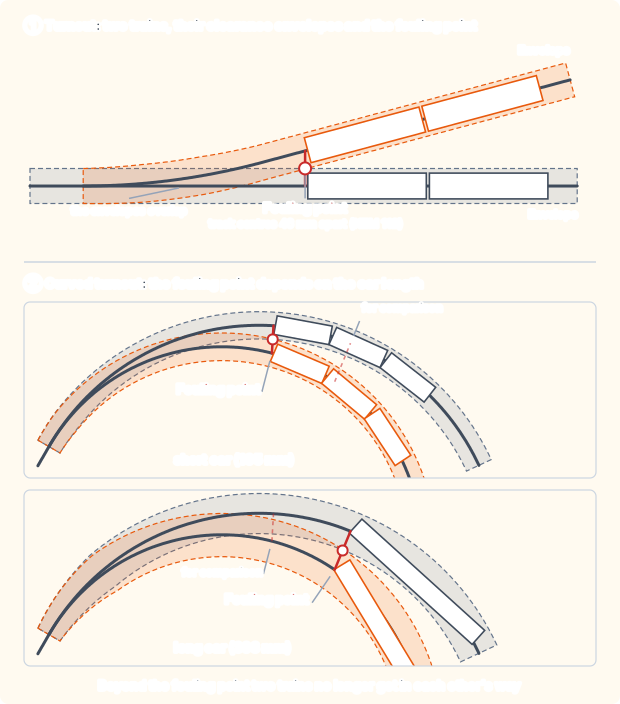
The fouling point marks the spot at a turnout or crossing beyond which a vehicle standing on one track would foul the clearance of the other (diverging) track. On the prototype it is a low marker set between the converging rails; on a model it follows from the geometry. It matters for planning because the usable length of a stub or storage track only counts beyond the fouling point — a vehicle stopped short of it blocks the turnout and makes the neighbouring track unusable.
Where it lies follows from the clearance envelopes of the two trains, the space their cars need as they run, safety margin included. The fouling point sits where the envelopes of the two tracks stop overlapping. On straight model track that happens once the track centres are as far apart as two parallel tracks under NEM 112 (H0: 46 mm). In a curve, a car swings its middle inwards and its ends outwards, a long car much further than a short one. On a curved turnout the fouling point therefore depends on car length: for long coaches it lies further beyond the turnout than for short wagons.